

When Scripture Is Symbolic Until It Needs to Be Literal
The problem is not reading sacred stories as myth. The problem is changing the rules whenever literal authority becomes emotionally useful.

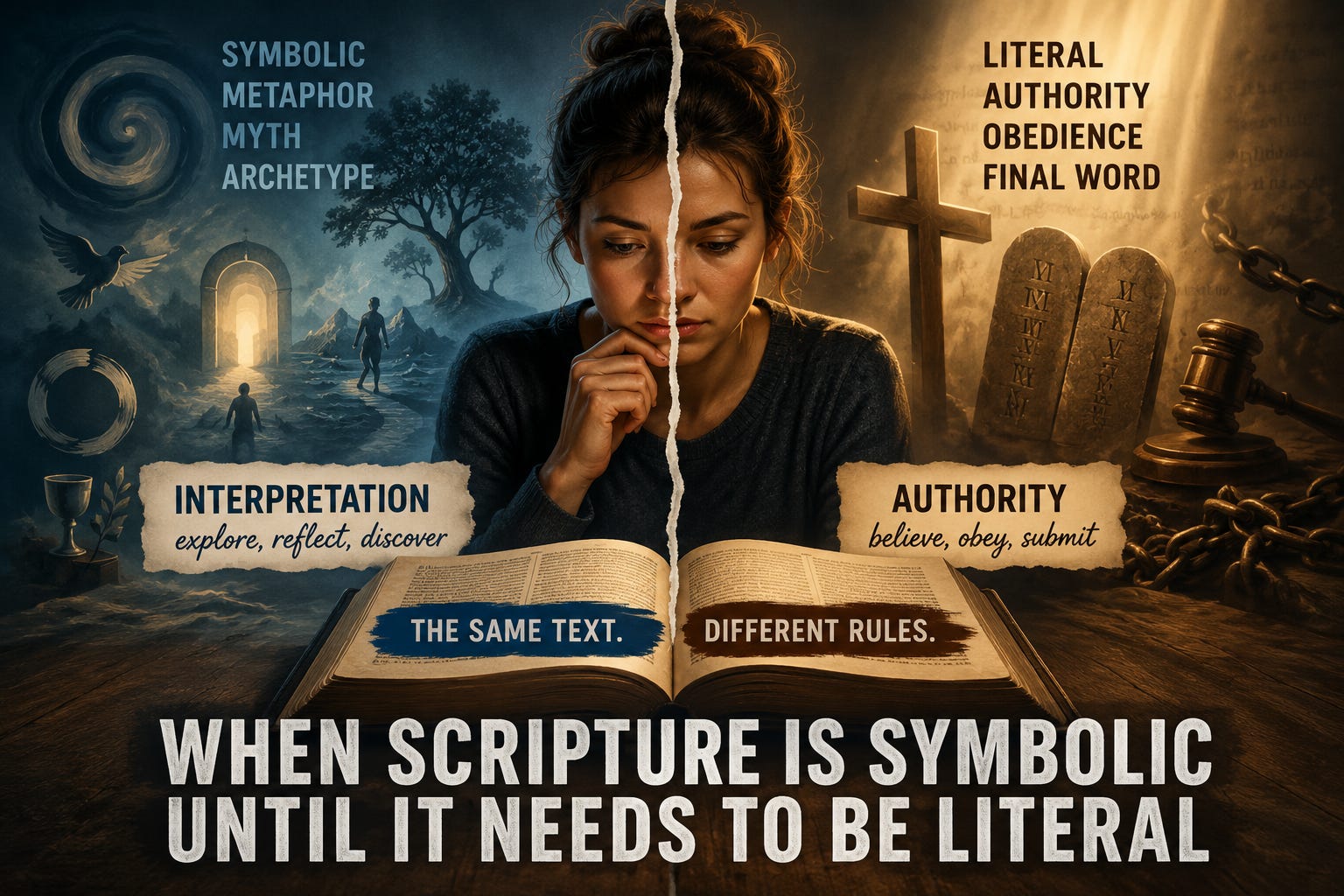
This reflection was sparked by a question from a reader (@HKA) who noticed something many spiritually curious people have felt but may not have named.
One of the most confusing things after religious deconstruction is watching people move between symbol and literal belief without telling you they changed lanes.
They will say the Bible is myth, metaphor, allegory, poetry, archetype, and encoded wisdom.
Then a few minutes later, they will quote a proverb, prophecy, saying of Jesus, or biblical phrase as if the words themselves carry unquestionable divine authority.
You have probably heard some version of it.
“Jesus is an archetype.”
“The Christ story is symbolic.”
“The Bible is encoded myth.”
Then the same conversation turns, and suddenly a verse is treated as if it settles the matter.
Not as a symbol.
Not as a poetic doorway.
Not as a cultural artifact.
But as a final word.
That shift matters.
Because if a text is being read symbolically, then the work is interpretation. If a text is being treated literally, then the work is obedience, proof, or submission to authority.
Those are not the same spiritual act.
And a lot of people blur the line.
The Confusion Is Not Always Obvious
This can happen with teachers, authors, commentators, and even people who sincerely believe they have moved beyond literal religion.
They understand myth when myth opens a door they like.
They understand metaphor when metaphor gives the story depth.
They understand archetype when archetype makes the Bible feel universal instead of narrow.
But when they reach a verse that still carries emotional power, they may suddenly treat the text as literal, divine, and binding.
That does not always mean they are being dishonest. Sometimes they are still under the authority system they think they have outgrown.
You can stop believing in literalism intellectually and still reach for literal authority emotionally.
That is one of the deeper wounds of religious programming. It teaches people to distrust their own discernment, then leaves certain phrases glowing with inherited power long after the belief system has been questioned.
So the person says, “This is symbolic.”
Then somewhere in the nervous system, another part of them says, “But this verse still has to be true.”
That is where the line blurs.
Symbol Is Not a Lesser Form of Truth
Part of the problem is that many people were trained to think literal truth is higher than symbolic truth.
If the event literally happened, it is real.
If it is symbolic, it is somehow weaker.
Kametaphysics reads this differently.
A symbol does not become less sacred because it is not literal. A symbol can become more useful because it reveals a process inside consciousness.
The question is not always, “Did this happen exactly this way in history?”
Sometimes the better question is:
What does this story reveal about awakening, fear, authority, identity, desire, guilt, resurrection, illumination, or inner conflict?
That does not make the story meaningless.
The symbol is no longer locked in the past. It becomes a mirror.
But a mirror is not a master.
And this is where discipline matters.
If you are reading symbolically, you cannot suddenly make the symbol literal just because you want the old authority back.
The Rule-Switch Is the Real Problem
The issue is not that someone quotes the Bible or finds wisdom in sacred text.
The issue is changing interpretive rules without noticing.
If the Bible is symbolic, then a verse is not automatically proof.
If the Bible is mythic, then a prophecy is not automatically a divine prediction.
If the Bible is allegorical, then a saying of Jesus must be interpreted, not simply obeyed because the text says he said it.
This is where many spiritual conversations become unstable.
People want the freedom of symbolism and the force of literalism at the same time.
They want myth when literalism becomes embarrassing.
They want literal authority when myth becomes too open.
But you cannot use symbolism as decoration and literalism as a weapon.
That is not interpretation.
That is selective authority.
A Symbol Is Not a Command
A mature symbolic reading does not require you to throw away biblical language.
It requires you to become honest about how you are using it.
If Jesus is being read as a symbol of awakened consciousness, then the work is to understand what that symbol reveals in the human being.
If light is being read as illumination, then the work is to ask where ignorance, fear, or inherited programming is being transformed into awareness.
If resurrection is being read symbolically, then the work is not to argue about a body leaving a tomb. The work is to understand what rises in a person when they are no longer identified with fear.
This kind of reading can still be sacred.
It can still be reverent. It can still change a life.
But it does not need to bully the reader with inherited authority.
It does not need to say, “Believe this because the Bible says so.”
It can say, “Look at the pattern. Look at what the symbol reveals. Look at what awakens in you when the story is no longer used to control you.”
That is a different relationship with scripture.
It is not blind belief.
It is not cynical rejection.
It is disciplined interpretation.
The Reader Has to Keep Their Discernment
For people leaving religious control, this distinction matters deeply.
Because the old system did not only teach beliefs. It trained a relationship to authority.
It trained people to feel that certain words outranked their conscience.
It trained people to treat certain stories as more trustworthy than their own body, grief, questions, intuition, and lived experience.
So when someone says, “This is all symbolic,” the liberated part of the reader may relax. But when that same person suddenly quotes a verse as literal authority, the old program can wake up again.
The reader may not know why they suddenly feel hesitation, guilt, fear of disagreeing, or the old reflex to submit.
This is why symbolic discipline matters.
Symbols should inform discernment.
They should not replace it.
Sacred stories can reveal patterns, but they should not become external masters.
The myth is not always the message.
Sometimes the myth is the doorway.
The deeper teaching is what the story reveals in you: the pattern, the inner conflict, the awakening, the fear, the authority you are still giving away.
A Better Question
The next time someone moves from symbolic language to literal authority, do not only ask whether you agree with the verse.
Ask what rule is being used.
Is this being offered as symbol?
Is this being offered as history?
Is this being offered as psychological truth?
Is this being offered as divine command?
Is this being offered as inherited authority wearing symbolic clothing?
That question can save you from confusion.
It can also save you from throwing away sacred language because someone else used it carelessly. You do not have to choose between literal belief and total rejection.
You can learn to read symbol without surrendering your discernment.
That is part of the reconstruction.
The sacred story does not need to dominate you to teach you.
And the moment a symbol demands obedience, it may no longer be functioning as a symbol.
It may be the old authority trying to return through a new vocabulary.
Hi Reginald! I’ve experienced this recently and had some thoughts about it. Thanks for sharing and helping me to understand what I was already thinking. NAMASTE 🙏
This is awesome 💥💯💪🏾❤️👏🏾